
In this article, learn why disability access and inclusion matters in local communities. Our Senior Consultant, Jane Britt, talks about the example of the Braille Trail campaign in Brisbane to show how advocacy can raise public awareness and support practical solutions.
Picture yourself walking down the street in the CBD of your closest capital city: it’s a din of noise with a bustling network of foot traffic and traffic. Now imagine someone with a white cane moving along the street. You notice they are sweeping their cane from side-to-side, touching those vertical raised tiles you’ve noticed before, but you never knew what they were there for. They stop suddenly though, something is on the ground, blocking their way.
Tactile ground surface indicators
Many people who are blind or vision impaired use white canes and guide or seeing eye dogs, and find their way around using tactile ground surface indicators (TGSIs). TGSIs are raised tactile features that provide orientation and mobility guidance to people with vision loss, including warnings about upcoming hazards. They can be rectangular tiles which help to provide direction, or circular tiles which indicate upcoming hazards like driveways, stairwells, or the edge of a railway platform.
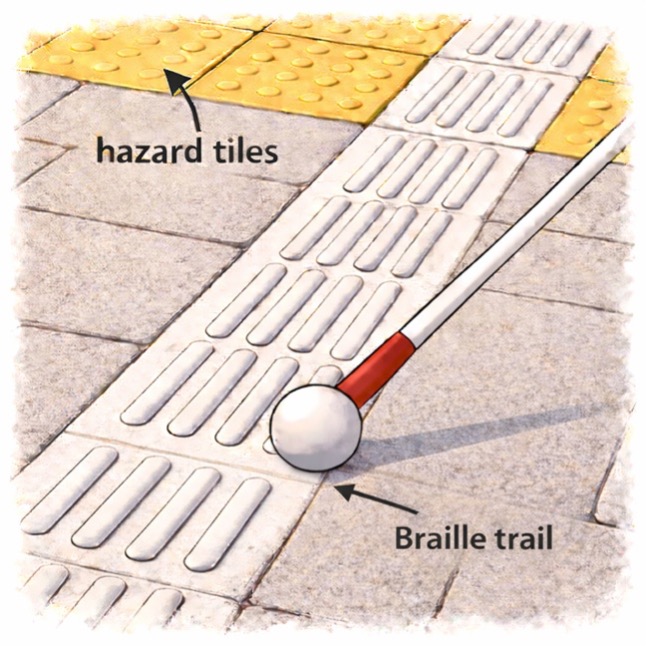
For people like me who are blind or vision impaired who use white canes, the tactiles help to understand the direction to walk in and be alerted to any upcoming hazards. If we feel the longer horizontal tiles, we know that’s the direction we need to head in, while feeling the round tiles makes us slow down to check if the Braille Trail is changing direction, or if there’s an upcoming hazard like stepping out onto a road with traffic, or that there are stairs ahead, amongst various other hazards.
People with guide or seeing eye dogs also use the trails to help with navigation and getting around.
The tactiles are used around Australia, especially in city centres.
The Braille Trail
In Brisbane City’s CBD, the Braille Trail (the rectangular tiles) runs 1.6 km through the Queen St Mall, and around surrounding streets. This trail is right in the heartland of Brisbane City. It’s a great initiative, but many people didn’t know it existed or what the infrastructure was for.
As a deafblind pedestrian in Brisbane, I was increasingly finding that the Brisbane’s CBD Braille Trail was being blocked by people and other obstacles. Beyond making it hard to move around the city independently, these blockages impact my safety — and the safety of anyone else who relies on the Trail.
When people or objects block the Braille Trail, it’s easy to become disoriented in knowing where I am and this leads to an increased risk of injury, particularly where obstacles are placed across the trail.
Often people aren’t intentionally blocking the path, but it’s the lack of awareness that causes people to become obstacles, by standing on it (in the way) to chat or check their phones, or by blocking it with objects - like putting down their bags. I’ve even encountered a BBQ in use placed across the trail at a local university.
Something needed to be done to make sure more people are aware of the Braille Trail.
So, how did I go from raising this issue with Brisbane City Council (BCC) to addressing all 128 NSW Councils about the same problem 10 months later?
An initiative is born
After identifying that the issues with access to the Braille Trail was likely being caused by the public having little to no awareness of it, I wrote to my local member to raise my concerns. My local Councillor connected me with the Council and they invited me to address a meeting. The Council agreed that low public awareness of the trail was leading to issues with it being blocked.
It was clear the public needed more awareness about the trail and why blocking it is a problem for people with vision loss who use it.
Brisbane City Council led a localised social media advertising campaign to raise awareness about the trail in the community. This included social media posts via Facebook, Instagram and TikTok that quickly reached over half a million views on Facebook. As of today, it has had over 1.3 million views on Instagram alone.
The comments on the social campaign confirmed my suspicions: many people had no idea what the Braille Trail was, or how people like me rely on it. This was an incredible outcome! If more people know about what the Trail is for, less people will block access to it.
I was determined to make sure the issue was acted on nationally. I wrote to Ministerial, Lord Mayor, and City Council offices across Australia and most responded positively. This led to opportunities through the NSW Disability Minister’s office — first to present to Sydney’s ‘super councils’, and later to address all 128 NSW Councils at a Disability Inclusion Action Plan meeting.
I’ve been thrilled to see more local councils now promoting awareness of the purpose of TGSIs and Braille Trails where they exist, as well as why they’re important to have.
This can lead to a greater path to independence for me and many others.
With that idea in mind, let’s revisit the picture I asked you to consider at the beginning of this blog.
Now, picture this. You’re strolling down that same city CBD street and as you walk, you notice that there is a Braille Trail to your right. There’s someone moving along beside the trail using a cane. As you glance at them, they pass without pausing. Nothing is in their way.
I’ve been thrilled to see more local councils now promoting awareness of the purpose of TGSIs and Braille Trails where they exist, as well as why they’re important to have.


